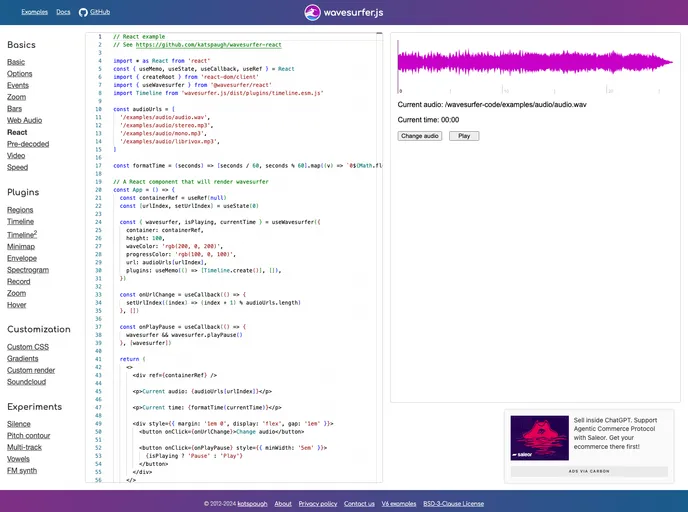
React component for wavesurfer.js
If you’re a React developer looking to integrate audio wave visualization into your application, @wavesurfer/react is an impressive choice that brings the power of wavesurfer.js directly to your React projects. This flexible library not only streamlines the use of wavesurfer.js but also allows it to seamlessly interact with React’s component model, making audio handling more intuitive.
With a straightforward API that transforms traditional wavesurfer options into React props, you’ll find it easy to build engaging audio experiences. It supports subscribing to various events, enabling you to create responsive applications that respond to audio playback in real-time.
Simple Integration: Easily integrates wavesurfer.js into React applications with minimal setup, allowing you to focus on building features rather than handling complex configurations.
React Props for Customization: Familiar wavesurfer options are transformed into React props, making it easy to customize the audio visualization directly from your React components.
Event Handling: Subscribe to a variety of wavesurfer events by using the ‘on’ prefix with event names, like onReady, which gives you access to the wavesurfer instance for further control.
Memoized Plugins: Supports passing wavesurfer plugins as a memoized array, ensuring stability and preventing errors due to mutations during initialization.
Flexible Usage: Can be used either as a React component or a custom hook, providing flexibility in how you structure your audio features.
Plugin Management: Allows defining plugins outside of components, optimizing performance, especially when the plugins don’t rely on component state or props.
Rich Documentation: Comprehensive documentation is available to help you get started quickly and address any questions about implementation details or usage patterns.